Foundations First
Just What’s Right: A Voice for Truth, Conscience, and Compassion

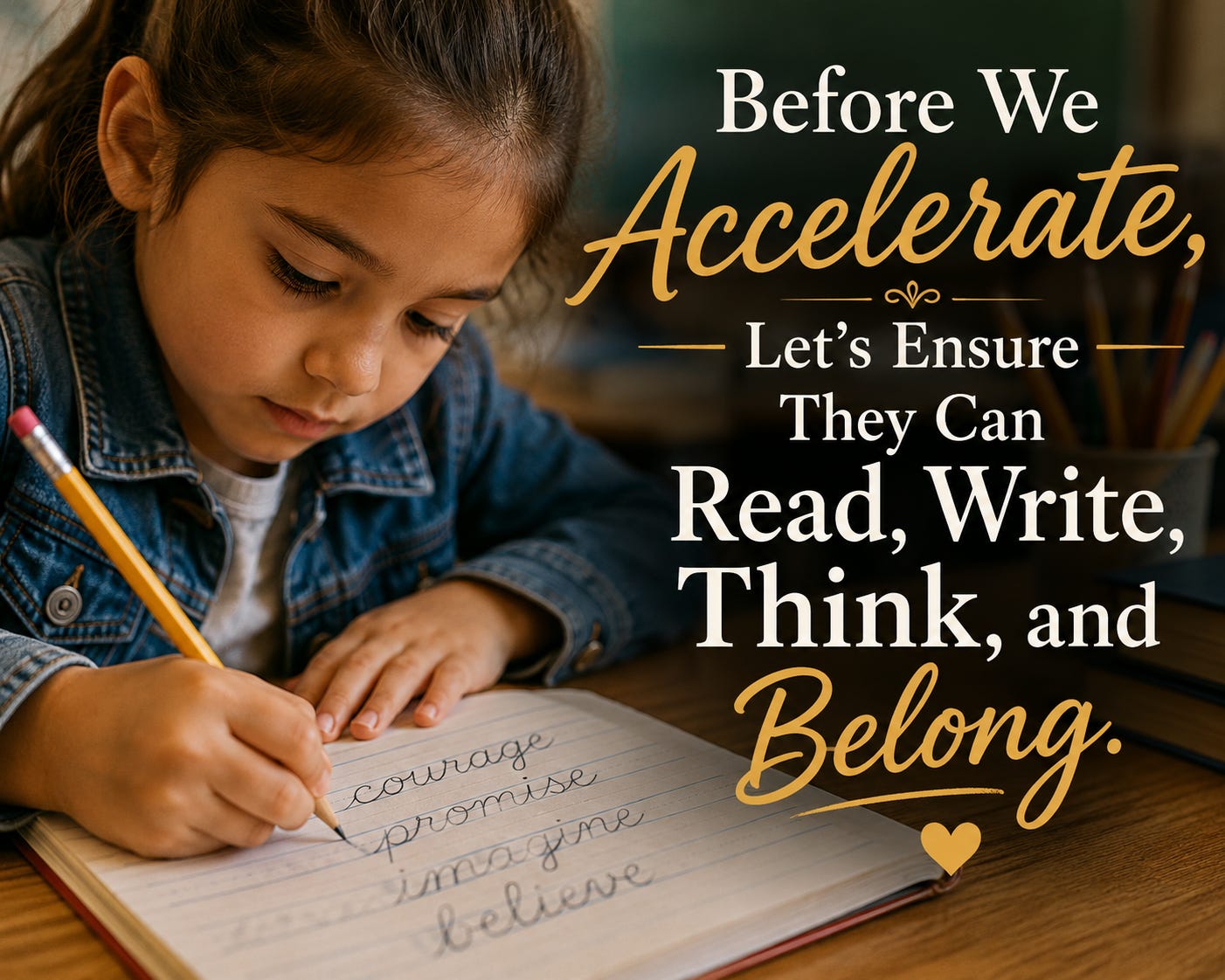
I watched a late-night comedy segment recently where young adults were asked to write simple words in cursive. None of them could do it. It was funny, of course. The audience laughed. The participants laughed. I laughed. But underneath the humor sat a more serious question: What foundational skills are we quietly abandoning before fully understanding why they mattered in the first place?
This is not really about cursive. It is about education.
Over the past several decades, American education has increasingly moved toward specialization, acceleration, and fragmentation. We now sort students into gifted programs, STEM academies, arts tracks, career pathways, advanced cohorts, intervention groups, pull-outs, and personalized learning models earlier and earlier.
Some of these programs are wonderful. Many change lives. But I worry we are building elaborate second floors while the foundation beneath too many children remains fractured. Far too many students across this country still struggle with basic reading and writing proficiency. Teachers report growing difficulty with sustained attention, comprehension, and communication. Employers and colleges alike describe students who can access information instantly but struggle to analyze, synthesize, or express it clearly. And perhaps most concerning of all, students themselves are beginning to internalize labels earlier and earlier. Advanced. Average. Hands-on. Not academic. Gifted. Struggling.
Children hear more than adults realize. When systems separate students too quickly, some begin to believe opportunity belongs somewhere else, for someone else.
That is not an argument against gifted education, Career and Technical Education, the arts, or advanced learning opportunities. Those pathways can be deeply meaningful and dignified. It is an argument for foundations first. ALL children deserve strong literacy, strong numeracy, exposure to arts and sciences, civic and social development, hands-on learning, and adults who believe their futures are still unfolding.
Children mature at different rates. A child who struggles in elementary school may flourish later in high school. A student who appears disengaged at twelve may become deeply focused at seventeen. Human development is uneven by nature. That is why I believe early education should emphasize broad exposure, strong neighborhood schools, foundational skills, and shared opportunity before heavy specialization begins.
Technology has only intensified this tension. Calculators arrived before number sense.
Devices arrived before discipline. Artificial intelligence is arriving before many students have mastered reading deeply or writing clearly. Technology should enhance learning, not prematurely replace foundational skills before they are fully formed. Put strong minds before strong machines.
The same principle applies beyond the classroom. In medicine, dentistry, aviation, engineering, and countless professions, technology assists, but human judgment remains essential. The machine cannot replace preparation, restraint, or understanding. Education should work the same way.
We should not confuse speed with depth. Access with knowledge. Output with understanding. Strong schools are not built through endless fragmentation. They are built by ensuring every child first learns how to think, communicate, solve problems, and develop confidence in their own ability to grow.
Specialization has its place. But foundations come first. That is not nostalgia. That is stewardship. And stewardship is just what’s right.
Because the truth doesn’t shout, it endures.